
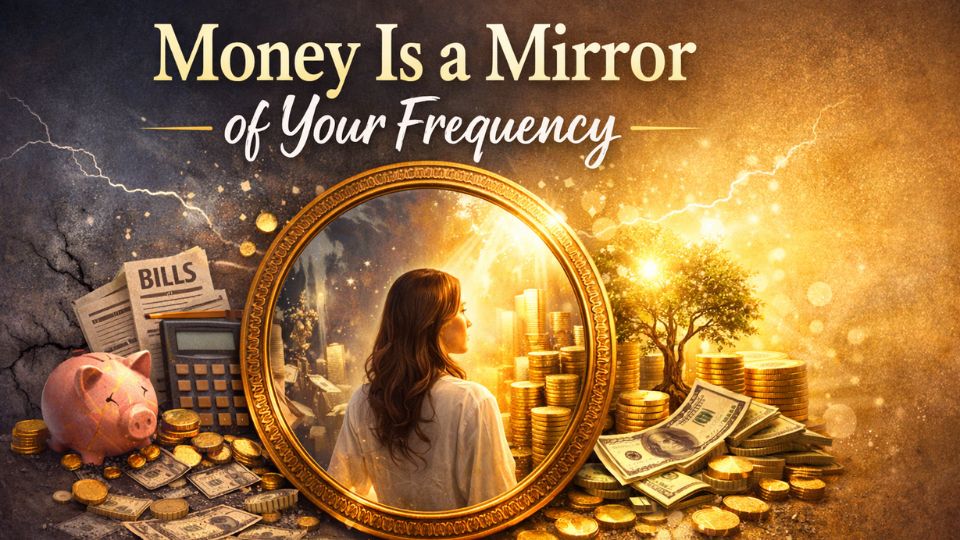
Money is rarely just about numbers. It is about how you think, how you feel, what you believe you deserve, and how safe you feel receiving and holding wealth.
Most people think money problems are about strategy — earn more, invest better, save smarter. But if strategy alone worked, every hardworking person would be wealthy.
The truth is deeper.
Money often reflects your internal state — your beliefs, emotional patterns, and subconscious expectations about wealth. And interestingly, modern research in psychology and finance is now confirming what spiritual and mindset teachings have been saying for years: your relationship with money is strongly influenced by your inner emotional world.
Let’s explore this in a simple, human way — with real facts, real psychology, and practical understanding.
Why Money Feels Emotional (Not Just Logical)
Here is something surprising:
Research shows that people make financial decisions about 90% based on emotion and only about 10% based on logic.
That means:
- Fear can stop you from investing
- Guilt can stop you from charging what you deserve
- Stress can make you overspend or avoid money decisions
Behavioral finance — a whole field of study — exists because emotions, habits, and subconscious beliefs strongly influence financial behavior.
In real-world investing studies:
- Nearly 70% of people admitted their investment choices were driven by emotions
- Over 80% showed fear-based behavior during market volatility
This is powerful. Because it means money problems are not always math problems. They are often emotional and energetic patterns.
The Reality: Money Stress Is Almost Universal
If you think you’re alone in worrying about money — you’re not.
Globally:
- About half of adults report being stressed about personal finances
- Around 87% experience financial stress at least once a week
- In some studies, 90% of people say money impacts their stress levels
Among young people worldwide:
- Over 57% say financial concerns are one of their biggest stress sources
Even when economies grow, people often don’t feel financially secure. Because financial security is not only external — it is psychological.
The Three Money Frequencies (In Real Life Language)
Let’s simplify the idea of “money frequency” into real, relatable patterns.
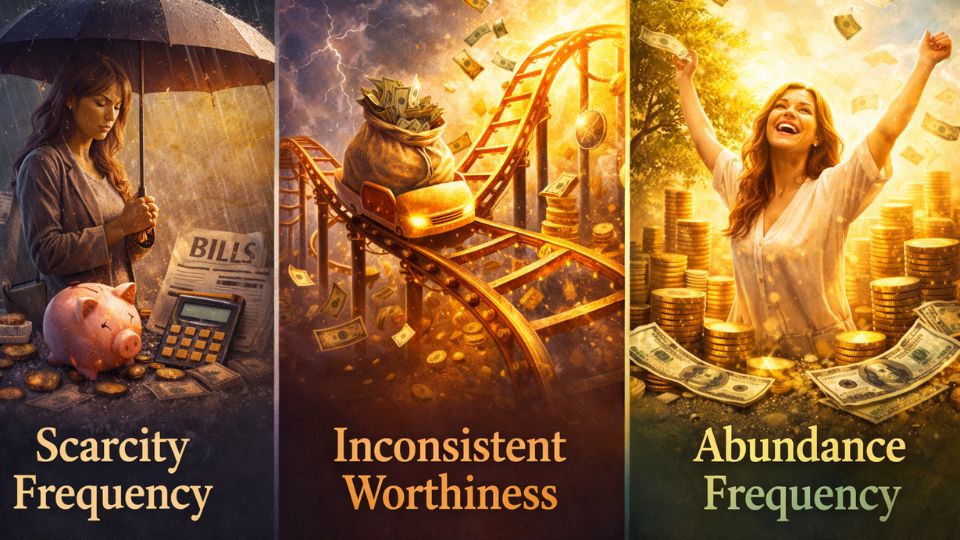
1️⃣ Scarcity Frequency — Survival Mode Money
How it feels
- Constant worry about bills
- Fear of unexpected expenses
- Feeling behind, no matter how hard you work
Typical beliefs
- “Money is hard to get.”
- “There is never enough.”
- “If I relax, I will lose everything.”
What research shows
Chronic financial stress can create anxiety loops where people avoid financial planning, overspend emotionally, or delay important money decisions.
2️⃣ Inconsistent Frequency — The Roller Coaster Pattern
How it feels
- Big money comes, then suddenly goes
- Bonuses disappear fast
- You earn well but don’t feel secure
Typical beliefs
- “I can earn money but can’t keep it.”
- “If I have too much, something bad will happen.”
Psychology explains this as emotional regulation through spending or self-sabotage patterns — when success feels unfamiliar or unsafe.
3️⃣ Abundance Frequency — Stability + Expansion
How it feels
- Money comes from multiple sources
- You feel calm about finances
- You trust money will continue flowing
Typical beliefs
- “Money is a tool.”
- “I am safe having wealth.”
- “There is always opportunity.”
This doesn’t mean rich. It means regulated nervous system + healthy money identity.
The Capacity Principle (Why People Lose Money After Getting It)
One of the most powerful money truths:
👉 You can only hold what you feel safe holding.
If wealth feels unsafe:
- You may overspend
- Make poor investments
- Undercharge
- Avoid opportunities
This matches neuroscience theories like somatic markers — where past emotional experiences shape future financial choices automatically. Your brain is trying to protect you — not make you rich.
Your Money Story Starts in Childhood
Many money beliefs come from early experiences:
- “Money causes fights”
- “Rich people are selfish”
- “We can’t afford this”
- “Security is more important than growth”
These become subconscious scripts.
And subconscious scripts = money frequency.
Why Hustle Alone Doesn’t Fix Money
You can:
✔ Work harder
✔ Learn strategies
✔ Follow financial advice
But if your internal identity says:
“I am someone who struggles financially”
Your behavior will unconsciously match it.
This is why:
- Some people earn more but feel poorer
- Some people earn less but feel secure
The Nervous System and Money Safety
Your body decides what feels “safe income level”.
If you suddenly earn more than your internal safety level: Your system may create situations to return you to “normal”. Not because you are weak. Because your brain loves familiarity.
Practical Ways to Shift Your Money Frequency (Science + Mindset)
1. Regulate Before You Strategize
If you are stressed, your brain goes into survival mode.
And survival mode = short-term money decisions.
Research shows financial stress reduces long-term planning ability.
So first step:
- Breathe
- Slow down money decisions
- Avoid panic actions
2. Create Micro-Abundance
Not fake luxury. Not overspending.
Just one area of: “I choose quality. I choose respect.”
Because identity shifts through repeated experiences.
3. Change How You Emotionally Handle Money In and Out
Instead of:
Money in → Relief
Money out → Fear
Try:
Money in → Appreciation
Money out → Trust + intention
This trains emotional association with money flow — not money fear.
4. Build Evidence of Financial Safety
Your brain believes experience, not affirmations.
Track:
- Income wins
- Smart decisions
- Savings progress
- Skills growth
This builds internal proof of abundance.
The Hidden Truth: Money Is Also Self-Worth
People who struggle to:
- Ask for payment
- Raise prices
- Negotiate salary
Often struggle with worthiness — not skill.
When identity changes, income often follows.
Imagine two freelancers with equal skill.
Person A:
“I hope clients don’t leave if I charge more.”
Person B:
“I deliver high value and charge accordingly.”
Over time:
Person B attracts higher-paying clients. Not always because of skill — but certainty.
Confidence is an economic signal.
The Future of Money Is Emotional Intelligence
Financial education is evolving.
It is no longer only:
- Budgeting
- Investing
- Saving
Now it includes:
- Emotional regulation
- Money identity
- Behavioral awareness
Because numbers follow behavior. Behavior follows beliefs. Beliefs follow emotional experiences.
The Ultimate Integration
Money is:
✔ Mathematical
✔ Psychological
✔ Emotional
✔ Energetic (in identity and behavior sense)
When your internal state changes: Your decisions change. Your risk tolerance changes. Your opportunities change. Your income patterns change.
Final Reflection
If money feels stressful right now — you are not broken. You are likely operating from patterns your brain learned for safety.
And patterns can be updated.
Not overnight. Not by forcing positivity.
But by:
- Awareness
- Emotional safety
- Identity expansion
- Consistent new experiences
Money is not just a result. It is feedback.
A mirror — not of your worth — But of your current beliefs, emotions, and sense of safety around receiving and holding wealth. And mirrors can change — when the person standing in front of them changes.
If you want spiritual support from us you can also explore our Money Attraction Bracelet – Click Here To Buy!