Today, it can be challenging to feel balanced, productive, and energized in our lives with all the stresses we have to manage every day, whether it be our work or family obligations. All of this constant stress ends up accumulating in our bodies, turning into physical tension and exhaustion.
While many wellness practices suggest reaching out to external sources of help, the wisdom of ancient cultures offers us another alternative, reminding us that the answer lies right inside of us. By learning to stimulate particular areas of our skin, you will be able to unleash your body’s natural potential for healing itself, releasing stagnant energy and welcoming a new influx of positivity into your life. Read on to learn some ways you can get started using simple acupressure techniques on a daily basis.
How Acupressure Works According to Traditional Chinese Medicine?
Acupressure is one of the key concepts of Traditional Chinese Medicine, which has been around since ancient times. It can be explained with the help of life force energy, or Qi, as it is called in Chinese philosophy.
Qi is said to move along particular paths in our bodies called meridians, of which there are 12 major ones corresponding to various internal organs. When our health is good, all energy in our bodies flows easily and freely through these pathways, much like water moving through a stream. However, stress, bad posture, lack of rest, and other similar factors lead to energy being dammed up within our meridians.
Applying deliberate pressure to certain points along those meridian lines causes your nervous system to respond, as if telling you to shift into relaxation mode. In physiological terms, it activates the release of endorphins and increases the production of nitric oxide, leading to increased local circulation, improved oxygenation, and reduced blood pressure. In this way, acupressure shifts your nervous system from its constant “fight or flight” mode to a “rest and digest” state of being.
7 Essential Pressure Points for a Daily Practice
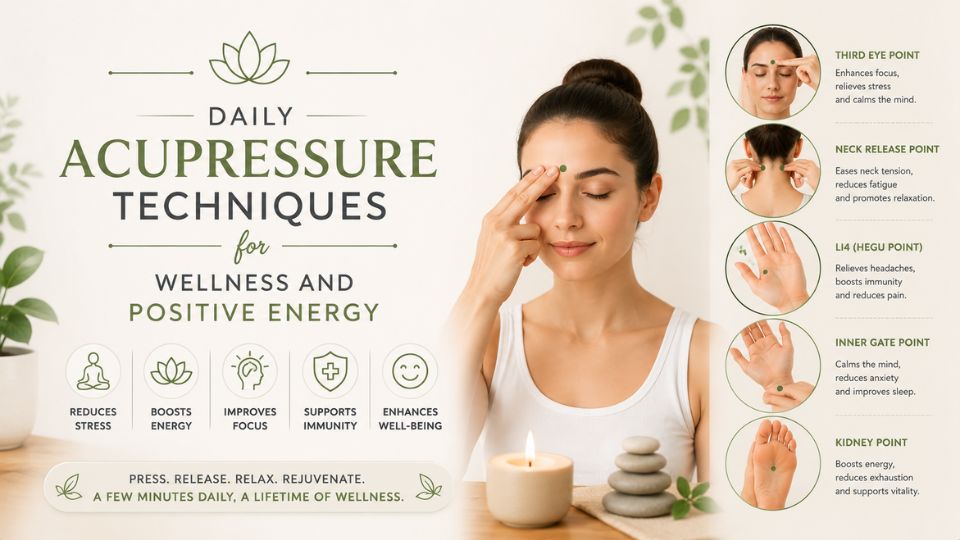
To develop an efficient acupressure routine, you don’t need to study all the complex points in Traditional Chinese Medicine. However, focusing on these seven points can significantly improve your well-being and eliminate many of your common health concerns.
1. DU20 (Baihui) – The Key to Mental Health
Common English Name: “Hundred Convergences”
Point Location: At the very top of your head, exactly on the central line of your skull. You can find it by imagining the line connecting the uppermost point of your ears going all the way to your head.
Reason for Using It: This is perhaps the most important point for people who spend much time working on computers. Stimulation of this point helps relieve mental fatigue, brain fog, reduces stress associated with excessive workload, and boosts your overall mood.
2. Large Intestine 4 (He Gu) – The Ultimate Reliever of Physical Tension
Common English Name: “Joining Valley”
Point Location: On the back of your hand, in the muscle located between your thumb and the index finger. To locate it, bring your thumb and index finger close and press deeply into this area.
Reason for Using It: Being the command point for the face and head, this location can help relieve most kinds of headaches and pains. He Gu can relieve migraines, sinus pressure, toothaches, and neck pains.
3. Liver 3 (Tai Chong) – A Way Out of Negative Feelings
Common English Name: “The Great Surge”
Point Location: On the top of your foot, between your big toe and the second one, about two finger-widths from where they split.
Reason for Using It: This point helps relieve emotional tension and anger. It allows negative energy to flow from your head downwards, helping relieve high blood pressure, PMS, and insomnia.
4. Yin Tang – Your Emotional Anchor
Common English Name: “Hall of Impression”
Point Location: Directly on your nose, exactly half-way between your eyebrows.
Reason for Using It: One of the most soothing pressure points for emotional health. When you are feeling anxious, worried, or overthinking too much, you can relax by applying gentle pressure to Yin Tang, allowing it to instantly lower your heart rate.
5. Stomach 36 (Zu San Li) – A Quick Energy Boost
Common English Name: “Leg Three Miles”
Point Location: On the outside of your lower leg, four finger-widths under the bottom edge of your kneecap, to the side of the prominent shinbone.
Reason for Using It: Traditionally, people believed this point could allow them to walk extra three miles. It is great for overcoming fatigue and mild depression, boosting metabolic rate, and physical endurance.
6. Pericardium 6 (Nei Guan) – The Nausea and Anxiety Anchor
Common English Name: “Inner Pass”
Point Location: Place your palm facing upwards. Put your three fingers horizontally along the crease of your inner wrist. The point is directly underneath your third finger, between the two tendons in your inner forearm.
Reason for Using It: Nei Guan is world-renowned as one of the best ways to deal with motion sickness, morning sickness, digestive issues, and nausea. Its proximity to the heart makes it incredibly helpful for alleviating the physical symptoms of anxiety, including a racing heartbeat and a tight chest.
7. Stomach 25 (Tian Shu) – The Core Balance Point
Common English Name: “Celestial Pivot”
Point Location: Found on the abdomen, exactly three finger-widths away from your belly button on each side.
Reason for Using It: Tian Shu acts as the master regulatory control over your whole gastrointestinal tract. Whether you are dealing with uncomfortable bloating because you ate too much, constipation, or diarrhea, a gentle massage will restore perfect harmony to your digestion.
How to Use Acupressure Points Safely and Effectively at Home?
In order to make sure you are getting the best possible benefits from daily practices of acupressure, you need to learn a little about the correct technique. These are as follows:
- Identify Your Pressure Point: Gently massage the general area until you find a spot that feels a little tender, warm, or heavy. This light sensitivity is an obvious indicator that you have found the energy point.
- Applying Pressure: Using the tip of your thumb, gradually increase pressure until you start feeling a deep pain, not a sharp or piercing one. If the pain is too intense, lighten the pressure.
- Circular Movements: Maintain the constant pressure with your thumb while making small circles, moving back and forth for two to three minutes per point.
- Deep Breathing: With each movement, breathe in deeply ten times, pulling the air down to the abdomen. Breathe in positivity and envision exhaling your tension into thin air.
- Do It Regularly: Make your new routine regular by practicing daily, several times a day if necessary. Try doing it while sitting at your desk, lying down to sleep, or even in the quiet room at home.
Conclusion
Learning how to use some basic pressure points is a powerful way to harness the power of natural healing. It allows us to recognize the ability we have to bring balance back into our lives with the help of body awareness. However, if you are interested in learning how to integrate these practices more fully into your life, it would be wise to complement them with proper therapy.
For a comprehensive guidance program tailored exactly to your body’s unique energy needs, get in touch with Babita Chaudhary. Her dedicated approach will help you dissolve chronic blockages, reclaim your vitality, and live a life filled with lasting positive energy.