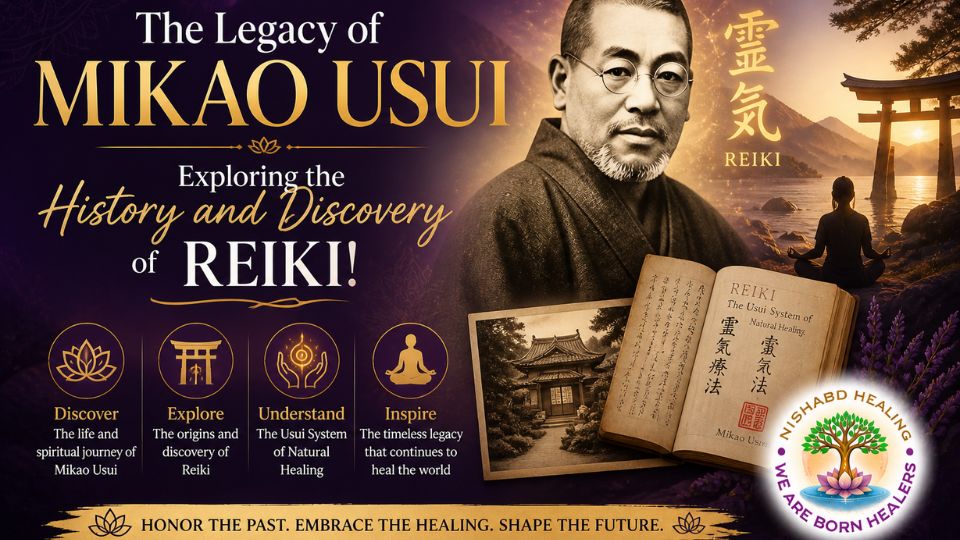
There is a broad range of different practices associated with holistic healing. However, there is one that seems to attract the most attention all around the world. Reiki can be found not only in specialized wellness centers and spas but also in some contemporary hospitals. Have you ever wondered about where this practice of “hands-on healing” came from? It wasn’t just a trend that appeared out of thin air; it was the result of a lifelong spiritual quest by a man named Mikao Usui.
The story of how he discovered the healing technique that made him famous is a fascinating tale of a dedicated researcher who had been searching for spiritual truth from his native Japanese village all the way to Mount Kurama. Read on to discover the fascinating history of Mikao Usui and the birth of Reiki.
The Formative Years: Mikao Usui’s Roots and Diverse Education
Born on August 15, 1865, in Taniai, which is a part of the Gifu Prefecture in Japan, Mikao Usui was in a unique position. It was the time of the Meiji Restoration which brought numerous changes to traditional culture, yet, at the same time, gave Usui access to numerous knowledge streams. Usui was a descendant of Chiba lineage which means that he belonged to samurais who were known for their strong spirituality, high level of education and devotion to different traditions.
It should be emphasized that, since childhood, Usui has been actively seeking for something. He was raised in a strictly Buddhist family and even went to a Tendai Buddhist Monastery at the age of four which introduced him to the basics of meditation and esoteric Buddhism. However, his education was not limited to only Eastern practices and philosophy. For instance, when he was still a child, he started showing extraordinary capabilities in studies and was eager to know more. As a result, he acquired skills in such areas as:
- Traditional Chinese Medicine: Usui knew the secrets of Qi (flow of energy) and meridians which can affect the human body.
- Martial Arts: He mastered the Yagyu Ryu school which helped him to understand how to concentrate and use internal energies.
- Western Science: He explored the fields of medicine, theology, and psychology and visited different European countries, as well as China, to learn more about health and soul.
Discovering Limitless Healing: From Exhausted Healer to Infinite Source
Before the official “discovery” of Reiki, Usui was already familiar with energy work. He practiced Kiko, the Japanese version of Qi Gong. While Kiko was effective for healing others, Usui found one major flaw: it relied heavily on the practitioner’s personal energy. He noticed that healers often felt exhausted and drained after treating patients because they were giving away their own “battery power.“
Thus, Usui started searching for the energy which would be limitless and allow him to help others without exhausting himself. As a result, he began studying ancient Sanskrit texts, Buddha and other Buddhist writings, and trying to understand how these famous healers managed to create miracles without losing their energy.
Sacred Event: Climbing Mount Kurama
A breakthrough moment took place in 1922. Fed up with unsuccessful attempts and frustrated by the lack of information, Mikao Usui made a decision. He went to Mount Kurama – one of the most spiritually strong places in Kyoto where he started to practice Isyu Guo – a 21-day retreat with fasting, praying and meditation.
After spending 20 days on the top of Mount Kurama without seeing any results, a miracle occurred. On the last day, he saw a “great light” hitting him right in the middle of his forehead. In a trance-like state, Usui started understanding all those old symbols written in Sanskrit in his mind. When descending the mountain, the man proved his powers and managed to perform three miracles:
- The Stubbed Toe: While going down from the top of the mountain, Usui stepped on a stone and his toe was hurt. Instantly, he healed himself with the help of his newly found technique.
- Meal: After 21 days of fasts, he ate plenty of food and didn’t feel the usual discomfort that occurs after the fast.
- Toothache: He healed a young girl’s toothache simply by placing his hands on her face while stopping for a meal at a local inn.
Systematizing the Method: The Creation of Usui Reiki Ryoho Gakkai
Usui understood the importance of applying spiritual experiences to improve society in a practical way. In April 1922, he moved to Tokyo and created the Usui Reiki Ryoho Gakkai (Usui Reiki Healing Society). Rather than keeping the technique private, he desired it to have a clear structure for people to learn it. For this purpose, he came up with:
- Attunements: A spiritual ritual when a master guides a student in aligning their energy channels with the universal flow.
- Hand Positions: A systematic approach allowing to send energy to different parts of the body through major organs and glands.
- The Five Principles (Gokai): Usui recognized that healing the body is temporary without healing one’s mind and resolving inner conflicts.
Living the Practice: The Five Reiki Principles for Spiritual Harmony
In order to ensure that his disciples remained at a high spiritual “vibration,” he provided them with the five Reiki principles to follow on a daily basis. He called these principles the “secret medicine” to treat any disease:
- Just for today, I will not be angry.
- Just for today, I will not worry.
- Just for today, I will be grateful.
- Just for today, I will do my work honestly.
- Just for today, I will be kind to every living thing.
With these principles, Reiki shifted its focus from addressing minor health issues such as curing backaches to balancing the soul. As long as the heart was pure and mind was free from worries and anger, the natural healing of the body would follow.
A Lasting Global Impact: From the Kanto Earthquake to the West
Usui became famous quite quickly. In the period of the Great Kanto earthquake in 1923, he assisted his students in treating many thousands of hurt people. Usui’s compassion earned him government recognition; moreover, during his lifetime, the number of students exceeded two thousand.
In preparation for death, Usui appointed 22 Reiki masters who could carry out his practice after him. One of the most significant of them was Chujiro Hayashi, the retired naval officer. Under his supervision, a Reiki center was opened in Tokyo where Hawayo Takata, an American of Japanese origin, was cured of her incurable disease. Afterward, she managed to spread Reiki practice in the United States.
Conclusion
As far as healing is concerned, Mikao Usui served as a bridge between Eastern spirituality and contemporary practices. With the creation of the Usui Reiki Ryoho technique, he gifted people with the possibility to heal both mentally and physically and to achieve spiritual peace.
His teachings continue to inspire individuals across the world to seek balance, compassion, and inner clarity in their everyday lives. Even today, the legacy of Reiki remains a timeless reminder that true wellness begins within.
Book Your Complementary Aura Scan With Babita Chaudhary!