
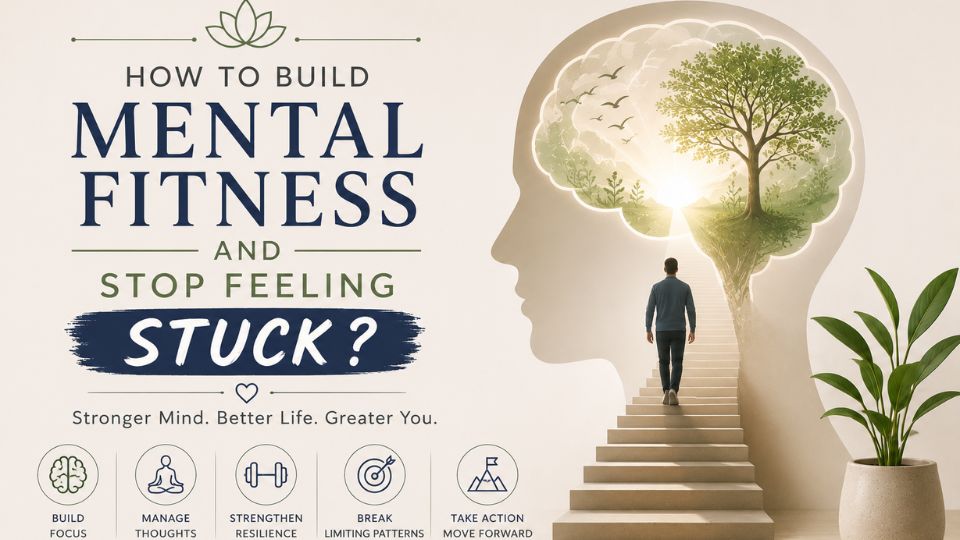
Have you ever felt the weight of heavy footsteps while trying to complete even the smallest tasks? Like you are walking through thick mud, making every effort to go further but only standing still? That is the classic symptom of feeling stuck, and it is not necessarily associated with lack of motivation or a busy schedule.
By developing habits that help you improve your emotional resilience, you can silence the negative voice and feel energized to steer your life again. Read on to discover the exact, practical strategies you need to boost your brain health, manage daily stress, and break free from the patterns holding you back.
The Psychology of Stuckness: Who is the Driver in This Case?
To understand why you feel stuck, it is essential to use a psychological metaphor called the bus. In this image, you are the driver. You are trying to drive a big red bus to the place of your goals, desires, and values in life. Now turn around and take a closer look at your passengers. They symbolize your thoughts, emotions, memories, and experiences.
- The Helpful Passengers: There are some really helpful passengers on your bus. They are always trying to give you a hand and support. They cheer you up and motivate you to try some new activities and remind you about your great qualities.
- The Difficult Passengers: There are also some passengers who try to discourage you and ruin everything with criticism and threats. They might say things like, “You are going to sound ridiculous if you speak out” or “You will get rejected” or “You are too inexperienced.”
As soon as the difficult passengers start shouting, we want to fight them. As you have very little resources here, you spend a lot of energy trying to throw them out of the vehicle.
In this case, you are giving control of the bus to those passengers. Thus, you are leaving the road that will help you reach your destination and turning onto another side-road which is absolutely safe and comfortable for passengers but definitely not satisfying for the driver.
What are Some Active Strategies to Build Psychological Hardness?
Emotional resilience doesn’t mean that you never feel fear, grief, or anxiety. It means that you know how to handle the difficulties in a healthy manner. Here are the most important steps in order to achieve psychological hardness.
1. Check-In and Identifying Feelings
It is impossible to solve a problem if it is not recognized. Throughout the day, take regular breaks to check how you are doing now. The simplest way to do it is to ask yourself a question “How am I doing right now?”
If you notice that you are stressed about an upcoming deadline, or upset because of an email, identify your feelings. Just naming them is a good method to calm the alarm system in your brain. If you deny your feelings, they will pile up until they burst like a steam engine. Identifying them will give you the opportunity to find out what you need right now in order to make it better.
2. Practicing Self-Compassion
We usually treat ourselves far more critically than anyone else would. If you make a mistake, the critic will take over your soul. In order to suppress it, you need to practice compassion towards yourself.
That is, you need to stop your inner critic and talk to yourself as if it were your best friend who had to solve a hard task. If someone told you that they failed in presenting a report, would you shout that they are not competent or useless? Or would you console and cheer up your friend, reminding them of their strong points? Do the same thing with yourself.
3. Separate Inconveniences from Catastrophes
When you feel overwhelmed, even small inconveniences become catastrophic. For example, getting stuck in traffic, spilling your coffee, or having a disagreement with your co-worker can seem catastrophic.
If you face any problems, ask yourself: Is this a catastrophe, or is it just an inconvenience?
A catastrophe is a major, life-changing event. An inconvenience is a minor, solvable problem. Understanding the difference between those concepts will prevent your nervous system from entering fight-or-flight mode. In case it is not a catastrophe, your brain switches its mode to solving problems and reminds you of other occasions when you have solved them before.
4. Take Small Steps Instead of Avoiding
In case you struggle with anxiety or depression, avoidance is your automatic reaction. You postpone important tasks, skip difficult conversations, and withdraw from social connections. However, by postponing things you need to get done, you contribute to building up more anxiety.
To tackle the task, break it into small pieces. Even if a public speech scares you, start by dedicating just twenty minutes a day to preparing the outline. Making small efforts towards completing the assignment boosts self-confidence and automatically improves your mood.
Everyday Habits to Improve Your Nervous System Functioning
Your nervous system significantly influences how you think, behave, and feel emotionally. To support healthy nervous system functioning, introduce simple habits into your routine.
Exercise Daily
Physical activities have a direct effect on your mind. Physical activity supplies your brain with extra blood and stimulates endorphin production. Exercise reduces stress, enhances sleep quality, and increases self-esteem. No matter what workout routine you pick, regular exercise greatly contributes to mental health.
Master the Box Breathing Technique
Stress makes people breathe shallowly, which means the brain interprets the situation as dangerous. One way to reduce the impact of stressful situations on your nervous system is to do deep breathing exercises. A particularly helpful technique is called box breathing, and here’s how it works:
- Breathe slowly for four seconds.
- Hold the breath for another four seconds.
- Exhale slowly for four seconds.
- Held in after exhalation for four seconds.
Repeat this procedure for one or two minutes to relieve your anxiety, stay grounded, and make conscious choices.
Develop a Good Night Routine
Proper sleep is crucial for your brain to process the information of the day and eliminate metabolic waste. Inadequate sleep negatively impacts your nervous system by preventing you from handling stress properly, regulating emotions and focusing on tasks. Make sure to turn off all devices an hour before sleep, use blackout curtains, and try to go to bed at the same time every day.
Shift Your Focus Using the Power of Gratitude
Our brains operate based on the so-called negativity bias. This means that our brains naturally focus on negative emotions while ignoring positive feelings. You can change these brain pathways with the help of gratitude exercises. Try to write down three positive things that happened to you every day. It can be your achievement at work, a nice drink, a conversation with a friend or something else.
Final Thoughts!
Remember that you cannot predict what lies ahead of you. Failures and mistakes are unavoidable parts of being alive. If you are never wrong and never make mistakes, you probably play it too safe and limit your possibilities.
Value the process as much as the result itself. Instead of sitting on your metaphorical bus and waiting impatiently until you reach your destination point, enjoy the scenery outside. Embrace the growth, surround yourself with people who understand you and confidently steer your bus.