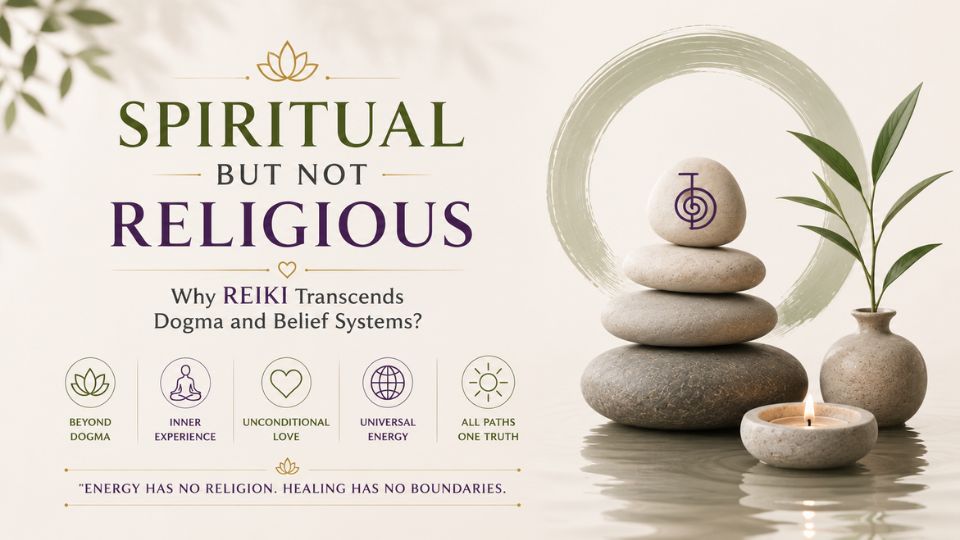
Living a life of high energy, technology, success, and social media means that many people today feel somewhat empty despite having everything that money can buy. It turns out that modern humans suffer from the malnutrition of the soul. Lately, even reputable media outlets such as the New York Times have acknowledged that human beings are spiritual beings by their very nature.
However, many people feel that religion is no longer relevant in modern times. Reiki is here to offer spiritual practice without subscribing to any religious doctrine. Read on to discover how this ancient Japanese art can nourish your spirit without requiring you to subscribe to a single line of dogma.
Understanding the Essence of Reiki
Reiki seems to be an enigmatic practice at first glance as one has to master symbols, learn the correct positioning of the hands and speak of “energy.” But, Reiki is neither a religion nor a new dogma; it is a spiritual practice aimed at reconnecting to yourself. Instead of following a list of commands, you are asked to pay attention to your bodily sensations.
The Difference Between Religion and Spirituality in Reiki
To understand why Reiki transcends dogma, we first have to look at what separates religion from spirituality.
Usually, religion consists of organized systems of rituals. Sacred texts, moral codes, and hierarchies are part of religions. One usually needs to “believe” in particular historical events and divine beings to belong to the religion.
By contrast, spirituality is about connectivity to something bigger. It represents an act of turning your consciousness inside to get connected with your true essence.
The words of people after a Reiki session or self-treatment often boil down to the following statement: “I feel better.” They do not say: “I believe the energy worked.” The point is that they know for sure it works because they feel a positive change in themselves. It is a sign of the spiritual healing process when you stop thinking about it and start knowing its effects.
Reiki as “Spiritual Medicine”
Reiki emerged in Japan in 1922 and used to be called “The Secret Art of Inviting Happiness.” Dr. Mikao Usui was a researcher who investigated the benefits of meditative practices and Buddhism. Nevertheless, Dr. Usui wanted Reiki to become universal. He understood that while we are all unique regarding our cultural or religious preferences, everyone shares the “Ki” energy in the.
As far as the Reiki technique goes, the term “Universal Life Force Energy” is utilized. People might interpret it as “light,” “love,” or even quantum physics fabric. Thus, the beauty of the practice lies in the fact that it is “belief-neutral.” In other words, you can be a devout follower of one religious belief or an atheist, whatever it is, Reiki energy will react to you positively.
Why Feeling Better Is a Spiritual Process?
Most people regard feeling better as a temporary effect of rest or relaxation. Yet, the state of being better is a significant spiritual indicator in the context of Reiki.
When you feel better, you stop filling your body with stress-related hormones. It enables it to enter the state of “rest and digest” and heal itself. Even more importantly, being better means that you are capable of doing better. You are able to make decisions from the position of abundance rather than scarcity or fear.
Spiritual practice is the key to finding your “Best Self.” Therefore, you can consider Reiki as a way of reaching for your inner best version. If you practice regularly, namely, every day, you can establish a spiritual practice that will accompany you throughout your life. Moreover, since the tools of Reiki are your hands, you can practice wherever you are. Be it the boardroom, the plane, or the house, your hands are always with you.
Five Precepts of Reiki
Even though there are no commandments in Reiki, it comes with the list of five precepts:
- Just for today, do not be angry.
- Just for today, do not worry.
- Just for today, be grateful.
- Just for today, work diligently.
- Just for today, be kind to every living thing.
Notice how these precepts focus on the present moment. They don’t ask you to promise a lifetime of perfection. Instead, they focus on today as the only moment that matters. This emphasis now explains why Reiki is considered spiritual practice. It helps you train your mind to focus solely on the present moment.
Can You Practice Reiki and Be Religious?
Since Reiki does not involve any dogmas, on the contrary, it can strengthen your existing spiritual views.
- For the religious: Practicing Reiki could be considered “meditative prayer”. In this case, it will be easier to get rid of distracting thoughts and establish the connection with the higher self and the Creator. Often people notice that the hands-on treatment performed during Reiki sessions resembles “laying on of hands” known in various religions.
- For the secular: If you do not have faith, Reiki can serve as a practical tool for managing stress, anxiety, and emotions without having to believe in the supernatural. For you, Reiki will be merely an approach that helps to regulate your electromagnetic field.
Reiki resembles the wind: you do not have to define it and become a member of any Wind Clubs to benefit from it.
Misconceptions: Why Does Reiki “Look” Religious?
It’s easy to see why people get confused. Reiki involves:
- Attunements: This process resembles initiation rituals because a practitioner helps to tune a student’s energy. However, despite this resemblance, this ritual is energetic rather than religious. There is no formal ceremony involved here.
- Symbols and Mantras: These two terms are used in Reiki as tools for concentration similar to formulas used in science and brushes used in art by artists. These techniques are aimed at helping to control intention.
- Chakras: Although the idea of these energy centers originated in India, in Reiki practice they represent the energy channels in the body. You do not have to believe in the existence of chakras for Reiki to help you.
Conclusion
Reiki is not about changing your belief system but rather how you live your life. The practice serves as a means of healing “the malnutrition of the soul” through establishing a physical and tangible link to the universal life force energy. It rises above cultural, linguistic, and religious barriers, speaking directly to that which is shared among all individuals: our humanity.
Being free from dogmas, it enables each practitioner to become their own healer. Moreover, it makes you trust your intuition and balance emotions thus creating more space in the mind and heart for new experiences.