There may come a time in your life when your lower back will start to ache. Whether you’ve slept the wrong way, worked too long at the office, or lifted something too heavy, your back may start to hurt. While some people turn to medication for instant relief, a natural and proven method exists.
Yoga has been used for centuries as a healing technique and has helped countless individuals relieve their chronic pain. In this article, we will explore the science behind why yoga works and walk you through five restorative poses designed specifically to soothe your spine. Read on to discover how you can reclaim your mobility and find lasting relief.
Why Does Yoga Help with Back Pain?
It might seem counterintuitive to move your body if you’re experiencing pain. However, your spine requires regular exercise to maintain its strength. In addition, your muscles require oxygen and nutrients to recover from stress and injury.
By incorporating specific poses, you’ll strengthen your body and increase flexibility. With regular practice, you can reduce your pain and improve your overall well-being.
Tips Before Starting
If you’re new to yoga or have recently had back surgery, you should consult a physician before attempting the following poses. Remember, yoga requires discipline. It would help if you focused on your body’s limits and didn’t try anything that could cause further damage.
Here are some useful tips:
- Don’t rush: Take your time with each exercise and make sure to follow the instructions carefully.
- Listen to your body: If you’re experiencing pain or discomfort, stop the exercise immediately.
- Be consistent: Try to practice these poses daily, even if you only have a few minutes to spare.
- Take your time: If you’re struggling with a particular pose, take your time and don’t force anything.
- Use props: Don’t be afraid to use blocks, blankets, and other props to support your body.
- Seek professional helpL: If you have any concerns or questions, seek advice from a professional.
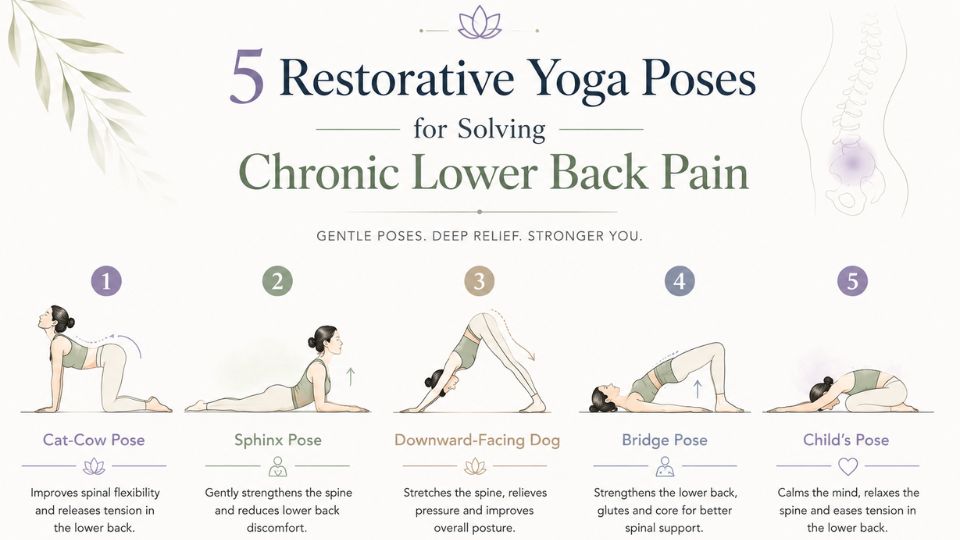
5 Restorative Yoga Poses for Lower Back Relief
These five restorative poses can help you relieve chronic lower back pain and improve your overall well-being.
1. Cat-Cow Pose (Chakravakasana)
It is an excellent exercise for improving your spine’s flexibility and strengthening your core muscles. This pose helps to release tension in your back and neck, promoting relaxation and stress reduction.
The Technique:
- Kneel on the floor with your knees hip-width apart and your hands shoulder-width apart.
- Inhale and arch your back, lifting your head and tailbone towards the ceiling.
- Exhale and round your back, bringing your head and tailbone towards the floor.
- Repeat the exercise for 1-2 minutes, alternating between arching and rounding your back.
2. Sphinx Pose
For those who spend a lot of time hunched over a computer, the Sphinx pose is a lifesaver. It is a passive backbend that helps restore the natural curve of your lower back. Also, it strengthens the spine and buttocks while stretching the chest and shoulders.
The Technique:
- Lie flat on your stomach with your legs extended behind you.
- Place your elbows under your shoulders with your forearms flat on the floor, palms facing down.
- Slowly lift your chest off the floor.
- Engage your lower abdominals slightly to support your back. Instead of “dumping” your weight into your lower spine, think about pulling your chest forward through your arms.
- Keep your gaze straight ahead and hold for 30 seconds to 1 minute.
3. Downward-Facing Dog (Adho Mukha Svanasana)
This pose is arguably the most famous in the yoga world, and rightfully so because it provides a full-body stretch, targeting the posterior chain – the muscles at the back of your body. It stretches the hamstrings and calves, relieving the “pull” sensation in the lower back. Also, it decompresses the spine as you allow gravity to gently pull your head and neck down.
The Technique:
- Begin in tabletop position.
- Tuck your toes under and press your knees away from the floor.
- Hike your hips high toward the ceiling, forming an inverted “V.”
- If your back is tight, don’t lock your knees. Instead, make sure your spine is straight throughout the pose.
- Press into the floor with your hands while spreading your fingers wide.
- Hold the pose for 5 to 10 deep breaths.
4. Bridge Pose (Setu Bandha Sarvangasana)
The Bridge pose targets the glutes and core muscles, both major stabilizers of the lower back. Lower back problems usually arise due to dormant glutes and tight hip flexors. This pose activates the glutes and stretches the hip flexors that get very tight from prolonged sitting.
The Technique:
- Start lying on your back with your knees bent and feet flat on the floor, hip-width distance apart.
- Extend your arms alongside your body with palms pressed against the floor.
- Inhale, squeeze your glutes and press your feet into the floor. Lift your hips towards the ceiling.
- Interlock your fingers behind you, but feel free to keep your arms down if interlocking is not comfortable for you.
- At the top, squeeze your glutes and hold for 30 seconds, then release your hips and roll them down one vertebra at a time.
5. Child’s Pose (Balasana)
This pose gives the lower back area a relaxing passive stretch. In addition to stretching the spine, the pose allows your vertebrae to be separated from one another. It also restores balance to your nervous system by calming it down.
The Technique:
- Get onto your knees and touch your big toes together. Sit on your heels.
- Separate your knees to about hip-width apart.
- Inhale, and hinge at your hips, folding forward until you’re resting your torso between your thighs.
- Rest your forehead on the floor while extending your arms in front of you or keeping them beside you on the floor.
- Feel how your spine extends with each inhale. Relax into this stretch for as long as you want.
Conclusion
Chronic lower back pain doesn’t have to become regular. By incorporating these five restorative yoga poses into your daily routine, you can begin to break the cycle of stiffness and discomfort. Yoga isn’t just about flexibility; it’s about building a stronger, more resilient body and a calmer mind. Remember to be patient with yourself because healing is a journey, not a sprint.